The people who can break down a carcass or run a filling line to spec are becoming rare in the exact decade demand for local, traceable food production grows. The apprentice pipeline collapsed a generation ago; the masters are retiring on schedule. For shops and processors, hiring is now a training operation with a recruitment front end - and the businesses that accept it early are quietly accumulating the region's remaining skills.
- Skilled butchery is a retiring trade with a vanished apprentice pipeline - assume you will train most future hires yourself.
- The work's realities - cold rooms, early starts, physical repetition - belong in the ad as filters, not surprises.
- Hygiene certification and food-safety discipline are screenable up front and trainable fast for the right temperament.
- Production retention is ergonomics, rotation and respect - the line keeps the people the schedule and the supervisor deserve.
The honest ad for hard work
Production hiring fails most often at expectation collision: the week-one discovery of what 4°C and repetition actually feel like. The cure is precision in the ad - start times, cold exposure, lifting reality, and the compensations: premiums, early finishes, the skill itself. Honest filters shrink the applicant count and multiply the day-30 survival rate, the arithmetic that vague ads never learn. Multilingual campaigns matter doubly here - production floors across Europe run on international crews, and an ad in the crew's languages with a two-minute application reaches workers boards never see, per multilingual recruitment.
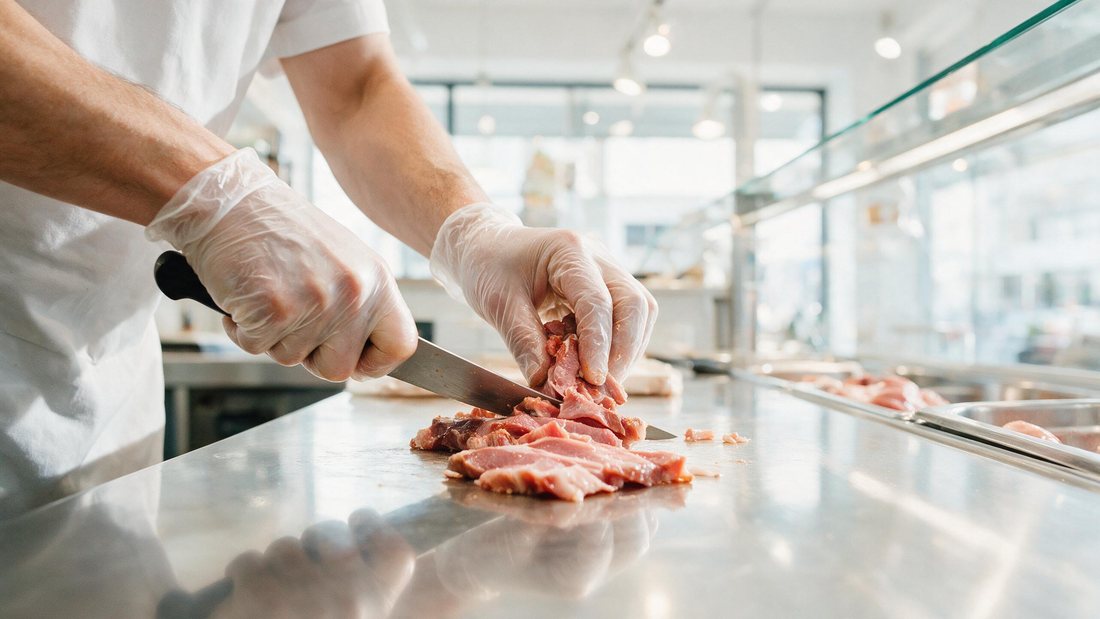
Screening for the line
- Knock-outs: shift availability, right to work, hygiene certificate or week-one willingness, transport for the early clock.
- Scenario questions, scored: the contamination near-miss, the colleague skipping glove protocol - food-safety temperament is measurable before day one, per quiz screening.
- The paid trial block: two hours at a station with a checklist - knife control or line rhythm, hygiene reflexes, instruction-following - decides what interviews cannot, per trial shifts.
- Skip the CV entirely for line roles; the trade lives in hands and habits, per hiring without CVs.
Making butchers: the training operation
Whether through formal apprenticeships where the system still functions or internal programmes where it does not, the pattern converges: a defined skills ladder (trim, portion, break, counter craft), funded courses with fair stay-periods, a master who actually teaches, and wage steps that track the ladder visibly. Career changers are the richest seam - kitchen refugees seeking structure, warehouse workers seeking a trade - and the recruiting message that lands is concrete: "qualified butcher in 24 months, paid from day one, course funded." The same pipeline mathematics as hiring apprentices, compressed for adults.
Keeping the line staffed
Production churn tracks three things: bodies (rotation, ergonomics and real breaks decide whether year two exists), rosters (predictable shifts and honored finish times, the eternal turnover lever), and respect (supervisors promoted for teaching, not shouting - and the craft consulted when processes change). None costs what replacement costs; all show up in the reviews and group chats where your next candidates are already reading about you, per employer reviews.
The takeaway
Assume the market will not send you trained butchers, and build accordingly: honest ads that filter, screening that tests temperament, paid trials at the station, and a training ladder that manufactures the skills you cannot buy. In a retiring trade, the shop that teaches becomes the shop that lasts.
Line staffed, counter covered?
Qwiza reaches production candidates in their feeds and languages, screens certificates, shifts and physical readiness up front, and returns ranked candidates - 48-hour pilot target.
See how Qwiza worksFrequently asked questions
Where do I find trained butchers when none apply?
Mostly by making them: the trained ones are employed, ageing, and poachable only with craft-and-conditions offers (equipment, no seven-day weeks, counter-plus-production variety). The scalable channels are career changers - kitchen staff wanting daylight structure, production workers wanting a skill - trained through your own programme or subsidised courses, and international recruitment where national schemes list butchery as a shortage occupation, which several do. Every serious meat business now runs training as a core function.
What certifications do production hires actually need?
Food hygiene basics before unsupervised work (a short certificate, trainable in days and often fundable), plus your HACCP-aligned onboarding; specific machines and knives carry their own competence requirements you document internally. Screen for the certificate or the willingness to get it in week one, and screen harder for the temperament that keeps standards at hour six - a scenario question about the dropped tray or the mislabelled batch tells you more than any paper.
How physical is too physical to hire for?
Be exact instead of dramatic: state the real lifting (kilos, frequency), the standing hours, the cold-room minutes per shift, and let candidates self-assess against facts - the honest-filter principle. Then engineer the job lighter: rotation between stations, lifting aids, proper mats and gloves. The trades' experience is consistent - honest ads plus ergonomic investment recruit a wider pool (including strong over-50 and returning candidates) than macho vagueness ever did.